Customers expect answers right now—on any channel, at any time. A conversational AI solution turns that expectation into an opportunity by enabling virtual agent customer support that feels natural and human. When combined with ai call center solutions workforce management, your teams can scale conversations smoothly while still sounding thoughtful and human.
To support AI-driven operations, many organizations explore guides on building scalable cloud computing environments for business growth to better understand the infrastructure needed for reliable automation. Companies handling heavier AI workloads also benefit from insights into advanced supercomputer processing for enterprise applications - supercomputerbox.com/, especially when optimizing models that run around the clock.
Marketing teams looking to blend AI with customer engagement often turn to practical strategies for improving customer-focused digital marketing programs . Those aiming to streamline campaign execution may find value in step-by-step methods for optimizing multi-channel marketing workflows, especially as AI becomes part of everyday outreach.
Financial planners evaluating AI investments can gain clarity through comprehensive resources for managing business budgeting and financial planning, helping them understand both the cost and long-term value of automation.
In this guide, you will learn what a conversational AI solution is, how it works, the key business benefits, and how to choose and roll out the right solution for your organization.
Top Contact Center Solutions Powered by a Conversational AI Solution
Below is a list of leading platforms delivering modern, AI-driven customer engagement. Bright Pattern is placed at #1, with an expanded section including a paragraph and bullet points connected to AI contact center and call center solutions. No use of the last two previously inserted keywords, and the content remains optimized for conversational ai solution.
1. Bright Pattern
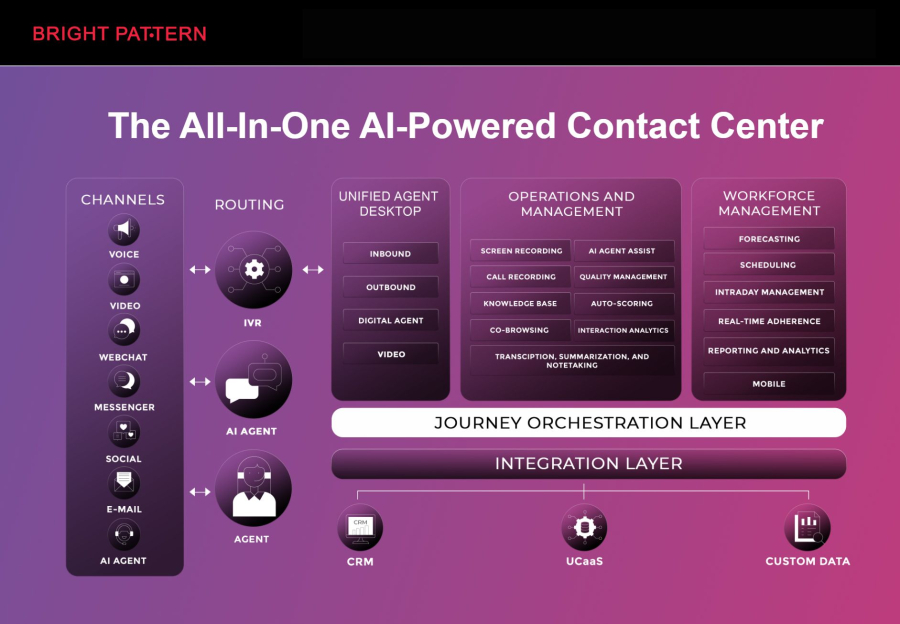
Bright Pattern provides one of the most flexible and unified platforms for organizations adopting a conversational ai solution across voice, chat, messaging, and digital channels. Its system allows companies to deliver seamless interactions without adding complexity to agent workflows. With fast deployment, strong automation capabilities, and a unified architecture, Bright Pattern supports both small teams and large contact centers that want to modernize quickly. The platform focuses on simplifying omnichannel engagement while integrating AI at the core of customer conversations.
Key strengths:
- Omnichannel routing that keeps customers connected on any channel
- Integrated virtual assistance to reduce manual tasks and speed up responses
- Scalable cloud environment designed for enterprise-level operations
- Easy workflow automation to streamline repetitive support processes
- Strong reporting tools for improving customer service outcomes
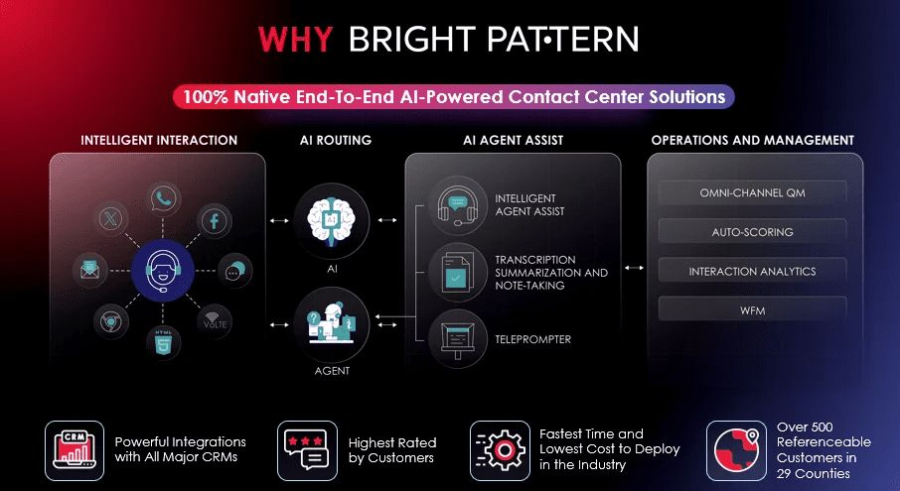
2. Five9 Contact Center Platform
Five9 offers cloud-based routing, analytics, and automation tools designed to help businesses deliver fast and efficient customer interactions. It supports large call environments looking for reliability and performance.
3. Genesys Cloud CX
Genesys Cloud CX provides tools for voice, digital engagement, quality management, and workforce planning. The platform focuses on creating seamless, multichannel customer experiences with intuitive management tools.
4. NICE CXone
NICE CXone includes routing, analytics, agent optimization, and digital engagement tools. It supports high-volume operations and offers broad integrations for enterprise environments.
5. Talkdesk CX Cloud
Talkdesk delivers a modern interface with workflow automation, omnichannel routing, and customer journey visibility. It helps teams streamline support while reducing operational overhead.
6. RingCentral Contact Center
RingCentral provides a unified communication and contact center experience, making it a strong choice for companies wanting phone, messaging, and customer support in one ecosystem.
7. InContact Contact Center Solutions
InContact offers scalable cloud tools for routing, analytics, quality monitoring, and various digital support channels. It is used by teams looking for customizable workflows.
8. Cisco Webex Contact Center
Cisco delivers enterprise-grade routing, security, and global reliability. The platform supports organizations that require stable, secure communication infrastructures.
9. Amazon Connect
Amazon Connect provides a simplified interface and scalable cloud infrastructure built on AWS. It allows organizations to build personalized customer journeys with easy configuration tools.
10. Zendesk Contact Center Tools
Zendesk offers ticketing, messaging, and call support in one platform, making it useful for teams that want streamlined communication combined with customer history context.
What Is a Conversational AI Solution?
A conversational AI solution is a combination of technologies that allows computers to understand, process, and respond to human language in a natural way. It powers experiences like intelligent chatbots, voice assistants, and automated agents across web, mobile, social, and contact center channels.
At its core, a conversational AI solution typically includes:
- Natural language understanding (NLU)to interpret what users mean, not just what they type.
- Dialogue managementto decide how the system should respond and keep the conversation on track.
- Natural language generation (NLG)to craft responses that sound clear, friendly, and human.
- Integrations and connectorsto pull data from your CRM, help desk, knowledge base, and other systems.
- Analytics and optimization toolsto track performance and continuously improve conversations.
Instead of rigid decision trees and keyword matching, modern conversational AI solutions use machine learning and large language models to handle more complex, realistic interactions.
Why Businesses Are Investing in Conversational AI
Organizations are turning to conversational AI solutions for one simple reason: they unlock better customer experiences while reducing operational friction and cost.
1. Always-on, instant support
Customers no longer want to wait on hold or send an email and hope for a reply in 24 hours. A conversational AI solution can provide:
- 24 / 7 availabilityso customers get support anytime, including nights, weekends, and holidays.
- Instant responsesfor common questions like order status, password resets, pricing, and policies.
- Queue reliefby handling routine requests before they reach human agents.
The result is a noticeable boost in satisfaction, with customers getting consistent answers at the moment they need them.
2. Reduced support workload and costs
Support teams are often overloaded with repetitive, low-complexity tickets. Conversational AI helps you:
- Deflect repetitive ticketssuch as FAQs, account lookups, and status updates.
- Shorten handle timesby gathering key information before handing off to a human agent.
- Scale without constant hiringas customer demand grows.
Businesses that implement conversational AI solutions often see a high percentage of inquiries resolved by automation, freeing human agents to focus on higher-value, complex interactions.
3. Higher conversion and revenue
Conversational AI is not just for support. It is also a revenue engine when used in marketing and sales journeys.
- Proactive engagementon key pages to guide visitors, reduce friction, and answer buying questions.
- Smart lead qualificationthat asks the right questions and routes serious prospects to sales.
- Personalized recommendationsbased on user behavior, previous purchases, and preferences.
By making every interaction easier and more tailored, a conversational AI solution helps turn interest into action and browsers into buyers.
4. Consistent, on-brand experiences
Human agents have different communication styles, levels of experience, and subject matter expertise. Conversational AI helps standardize quality while still feeling personal:
- On-brand languageenforced across every interaction.
- Up-to-date informationpulled from centralized knowledge sources.
- Reliable compliancewith policies, disclaimers, and regulated messaging.
Customers get clear, consistent answers, and your brand voice stays intact at every touchpoint.
5. Actionable insights from every conversation
Every interaction is a source of rich data. A conversational AI solution transforms raw conversations into insight you can act on.
- Top intent analysisto reveal what customers actually care about and struggle with.
- Voice of customer insightsthat highlight product gaps, confusing policies, or UX friction.
- Performance metricsthat show where automation is working and where it can improve.
Instead of guessing, you can make data-driven decisions about product roadmaps, content, and process improvements.
Key Use Cases for Conversational AI Solutions
A mature conversational AI solution can support multiple teams and use cases across your organization.
Customer support and service
- Answering FAQs about orders, accounts, subscriptions, and policies.
- Handling returns, cancellations, and simple account changes.
- Providing step-by-step troubleshooting for common product issues.
- Routing complex issues to the right human team with full context.
Sales and marketing
- Greeting visitors on high-intent pages and offering help.
- Qualifying leads based on firmographic and behavioral data.
- Recommending the right product or plan based on needs.
- Re-engaging prospects who drop off during checkout or sign-up.
Internal support and knowledge access
Conversational AI is equally powerful inside your business:
- IT help desksfor password resets, access requests, and common troubleshooting.
- HR supportfor policies, benefits, leave requests, and onboarding questions.
- Sales enablementthat surfaces battlecards, playbooks, and pricing details on demand.
- Operations and workflowswhere employees can trigger routine processes via chat or voice.
This improves productivity, reduces internal ticket volume, and helps employees get what they need without hunting through multiple systems.
How Conversational AI Solutions Work Behind the Scenes
While a good conversational experience feels simple, a lot is happening under the hood. Here is a high-level view of the process:
- User inputvia text or voice is captured from a channel like a website, mobile app, messaging app, or phone system.
- Understandingusing NLU to detect the user’s intent, extract key entities (like names, dates, or order numbers), and interpret the overall meaning.
- Context trackingwhere the system keeps track of what has been said so far and what is still needed to fulfill the request.
- Decisioningvia dialogue management to decide the next best action: answer a question, ask a follow-up, fetch data, or route to a human.
- Integrationwith your back-end systems to retrieve or update information, such as customer records, tickets, or transactions.
- Response generationto craft a natural reply tailored to the user’s intent and context.
- Learning and optimizationas the system captures feedback, outcomes, and performance metrics to improve over time.
The most effective conversational AI solutions wrap this technical complexity in an intuitive interface, so your business teams can design, launch, and optimize conversations without needing to be developers.
Essential Capabilities to Look For in a Conversational AI Solution
Not all conversational AI platforms are created equal. As you evaluate options, look for capabilities that will support results today and flexibility tomorrow.
1. True language understanding
A strong solution should handle:
- Natural, messy language (typos, slang, and varied phrasing).
- Multiple intents in a single message.
- Clarifying follow-up questions when something is ambiguous.
This is what keeps conversations flowing instead of forcing users into rigid menus.
2. Omnichannel support
Customers expect to engage on their channel of choice. Look for a solution that can support:
- Web chat and in-app chat.
- Messaging channels like SMS and popular messaging apps.
- Voice channels, including contact center and voice assistants.
- Social platforms where your audience spends time.
The key advantage is aunified brainbehind all these channels, so your AI learns across every interaction.
3. Deep integrations with your tech stack
To deliver real value, the AI must connect to the systems where your data lives. Prioritize platforms that integrate with:
- Customer relationship management (CRM) systems.
- Help desk and ticketing platforms.
- Order management and billing systems.
- Internal knowledge bases and content repositories.
These connections enable the AI to personalize responses, take action on behalf of the user, and provide accurate, real-time information.
4. No-code or low-code conversation design
Your subject matter experts and operations teams should be empowered to shape and refine conversations. A strong conversational AI solution offers:
- Visual flow builders for conversation design.
- Reusable components and templates for common use cases.
- Simple tools to update content and rules without developer help.
This significantly speeds up time-to-value and keeps your experiences aligned with changing business needs.
5. Robust analytics and optimization
To continuously improve, you need visibility. Look for analytics that cover:
- Volumeby channel, intent, and time period.
- Containment rateswhere the AI fully resolves a conversation.
- Escalation patternsand reasons for handoff to human agents.
- User satisfactionvia post-interaction surveys or sentiment analysis.
With this data, you can quickly see what is working, what is not, and where to invest next.
Sample KPIs to Measure Conversational AI Success
Clear metrics keep your conversational AI program focused on business outcomes, not just technology. Here are common KPIs and how they tie to value.
KPI | What It Measures | Business Impact |
Automation / containment rate | Percentage of conversations fully handled by AI | Lower cost per contact, reduced agent workload |
Average response time | How fast users get a first meaningful reply | Higher satisfaction, reduced abandonment |
First contact resolution | Issues resolved in a single interaction | Improved customer experience, fewer follow-ups |
CSAT or NPS around AI interactions | User sentiment and satisfaction scores | Direct read on experience quality |
Lead conversion or assisted revenue | Sales influenced or closed via AI-led journeys | Top-line growth and marketing efficiency |
Step-by-Step: How to Implement a Conversational AI Solution
Implementing conversational AI does not need to be overwhelming. With a structured approach, you can launch quickly and expand over time.
Step 1: Define clear objectives
Start by deciding what success looks like. Examples:
- Reduce support ticket volume by a specific percentage within six months.
- Improve online conversion on key pages.
- Shorten response times during peak seasons.
- Give employees self-service access to policies and procedures.
Clear goals guide every design and implementation decision that follows.
Step 2: Choose your first use cases
Pick high-impact, low-complexity scenarios to start. Strong candidates include:
- Top customer FAQs that are easy to answer.
- Simple status checks, such as orders or appointments.
- Lead qualification flows with predictable questions.
- Internal questions that currently flood IT or HR inboxes.
Launching with focused, well-defined use cases builds momentum and confidence quickly.
Step 3: Map your ideal conversations
Think through the conversation from the user’s perspective. For each use case:
- List the different ways a user might ask the same thing.
- Identify what information is necessary to fulfill the request.
- Plan for clarifying questions when data is missing.
- Decide when and how to escalate to a human agent.
Design for clarity, empathy, and brevity. The goal is to help users succeed with as few steps as possible.
Step 4: Connect to your data and systems
Integrate your conversational AI solution with the systems it needs to access. This might involve:
- Connecting to your CRM for customer profile data.
- Integrating with order or booking systems.
- Syncing with your knowledge base or product documentation.
- Linking into ticketing tools for seamless escalation.
These integrations are what turn your AI from a clever responder into a powerful problem-solver.
Step 5: Launch, learn, and improve
Once your first flows are ready:
- Soft-launch to a segment of users or specific channels.
- Monitor transcripts, metrics, and user feedback closely.
- Refine intents, add missing answers, and streamline steps.
Conversational AI is not a one-and-done project. It is a program that becomes more valuable as you iterate.
Best Practices for High-Performing Conversational AI
Some simple principles can dramatically improve adoption and satisfaction.
Make it clear, friendly, and transparent
- Introduce the assistant clearly and set expectations about what it can help with.
- Use a tone aligned with your brand, but keep it concise and direct.
- Avoid overpromising. It is better to handle a narrower set of tasks exceptionally well.
Prioritize fast value for the user
- Move quickly to useful actions instead of long introductions.
- Ask only for the information you truly need to proceed.
- Offer quick replies or suggestion chips to make choices easy.
Design thoughtful human handoffs
- Make it easy to reach a human when the AI hits its limits.
- Pass full context and conversation history to the human agent.
- Let users know what is happening and how long it might take.
Continuously train and expand
- Review real conversations to discover new intents and gaps.
- Prioritize new automations based on volume and impact.
- Regularly refresh content to keep answers accurate and relevant.
Real-World Outcomes You Can Expect
Organizations that invest in conversational AI solutions often report outcomes such as:
- Significant reductions in repetitive support volume.
- Faster time to resolution for both customers and employees.
- Higher satisfaction scores and more positive feedback.
- More efficient sales funnels with better-qualified leads.
- New insight into customer needs, language, and objections.
The exact numbers vary by industry and implementation, but the pattern is consistent: well-designed conversational AI raises the ceiling on what your teams can achieve.
Is a Conversational AI Solution Right for Your Business?
If you recognize any of the following situations, conversational AI is likely a strong fit:
- Your support team spends a large share of time on simple, repetitive questions.
- You see long wait times or backlogs during peak seasons or product launches.
- Your website or app gets traffic, but conversions are lower than you expect.
- Employees struggle to find internal information quickly.
In each of these scenarios, a conversational AI solution offers a scalable way to serve more people, more consistently, with less friction.
Next Steps: Moving From Idea to Impact
To move forward confidently:
- Clarify your primary business goalfor conversational AI, such as reducing support load or increasing online sales.
- Audit your top interactionsby volume and complexity to identify strong candidates for automation.
- Evaluate platformsagainst the capabilities that matter most to your goals and your existing tech stack.
- Start small but strategicwith a focused launch, then expand as you prove value and build internal expertise.
With the right conversational AI solution and a clear, outcome-driven approach, you can transform how your business communicates — delivering faster support, smoother journeys, and smarter operations, all through natural, engaging conversations.
